Chemical Sourcing in India Shifts Under Pressure from West Asian Turmoil
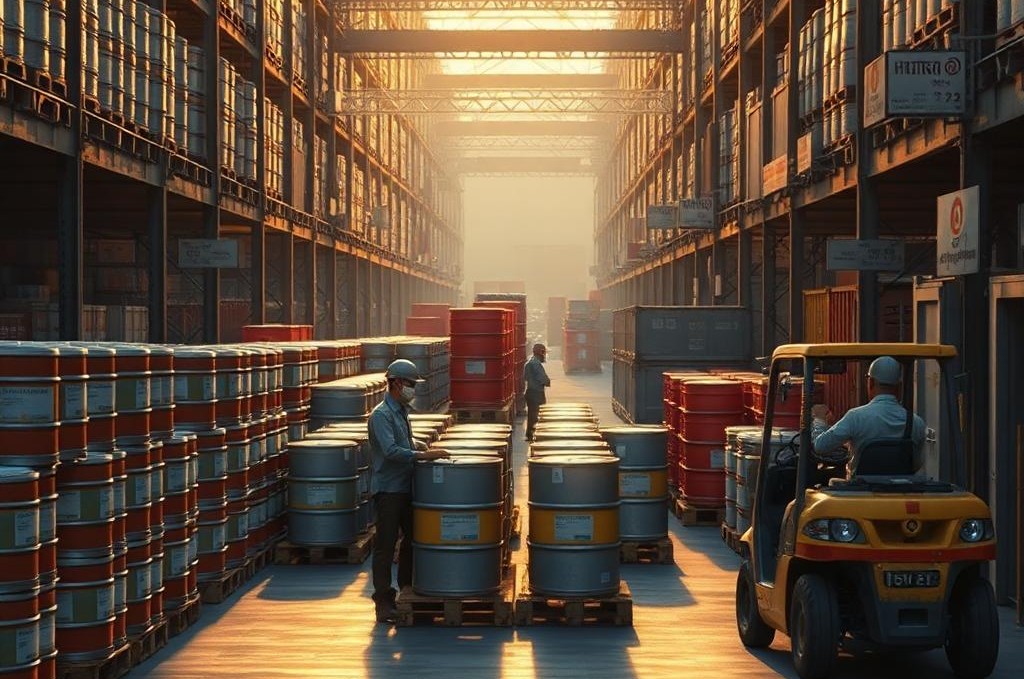
Image: AI-generated
West Asia in Crisis, India Searching for Alternatives
Regional instability led to delays, cancellations and highly unpredictable delivery times. For a country like India, where the chemical sector is a crucial link in industries such as pharmaceuticals, textiles, plastics and agriculture, such disruptions are more than an inconvenience: they affect the entire production chain. As a result, many companies shifted their priorities from purely price‑driven procurement to a mix of price, security of supply and geopolitical risk.
China Seizes the Moment as Emergency Supplier
Into the gap created by the problems in the Gulf stepped one country in particular: China. Chinese producers and traders managed to ramp up their exports to India sharply in a short period of time. According to data from India’s Ministry of Commerce, cited by Chemical Industry Digest, China supplied India with more than 225 million dollars’ worth of additional organic and inorganic chemicals in March and April 2026 combined. As West Asian suppliers dropped out, China positioned itself as a reliable and, above all, fast‑moving partner.
Strong Growth Figures for Chinese Chemical Exports
The numbers show just how dynamic the shift has been. Chinese exports of organic chemicals to India reached 425.52 million dollars in March 2026, up 12.6 percent compared with a year earlier. Growth accelerated in April, when exports rose to 560.82 million dollars, a year‑on‑year increase of 37.4 percent. The picture was similar for inorganic chemicals: after a slight dip in March, exports jumped in April to 109.79 million dollars, 40.4 percent higher than in April 2025. China is thus firmly positioning itself as the supplier of first choice when other sources falter.
Heavy Losses for Traditional Gulf Suppliers
For the Gulf states, the West Asian crisis has meant a sharp decline in their position in the Indian market. Saudi Arabia, long one of the key players, saw its exports of organic chemicals to India collapse by 82.8 percent in April 2026: from 127.54 million dollars a year earlier to just 21.94 million. Over March and April combined, the loss exceeded 100 million dollars. Other countries, such as the United Arab Emirates, also saw volumes plunge. Exports of inorganic chemicals from the UAE dropped from 6.53 million dollars in April 2025 to just 0.95 million in April 2026. This steep decline highlights how vulnerable established trade relationships become when geopolitics and logistics turn against them.
Market Share Tilts Towards China
The impact is clearly visible in market share figures. China was already an important supplier, but has significantly strengthened its position. The Chinese share of India’s imports of organic chemicals rose to 41.8 percent in April 2026, up from 29.4 percent a year earlier. In inorganic chemicals, its share increased from 15 to 17.4 percent. In a short space of time, India has thus become noticeably more dependent on a single dominant supplier – precisely at a moment when companies worldwide are trying to build resilience and spread risk.
Concerns Over Dependence, and Opportunities for Local Production
For India’s chemical industry, this shift brings both risks and opportunities. On the one hand, China’s willingness to supply offers a vital lifeline in times of scarcity. On the other hand, fears are growing of a new form of one‑sided dependence – this time not on the Gulf, but on China. Policymakers, producers and traders are therefore increasingly stressing the need for diversification: tapping more sources, for example in Southeast Asia, signing long‑term contracts, and building strategic stockpiles. At the same time, calls are mounting for investment in domestic production capacity so that India becomes less vulnerable to international volatility.
A New Reality for Indian Procurement Strategies
How lasting this shift towards China will be remains unclear, according to analyses by, among others, moneycontrol.com. Much will depend on how quickly the situation in West Asia stabilises and to what extent Indian companies are willing to return to their traditional suppliers. What is certain, however, is that the events of 2026 have once again shown how rapidly global trade flows can be reshaped by regional tensions. For India’s chemical sector, agility – the ability to switch between suppliers, regions and contract structures – is becoming just as important as price. Those wishing to thrive in this new reality will have to focus on diversification, strategic planning and a stronger domestic industry.
Source: ET Chemicals.in
Also read: Why India’s farmers are Stuck between ideal and reality
Reservation
This information has been compiled with the greatest possible care, in some cases from different information sources and sometimes with the help of AI. (Interpretation) errors are not excluded. No legal obligation can therefore be derived from this text. Everyone dealing with this subject has the responsibility to delve into the matter!