News
New requirements for hazardous …

… substances in the UK. The Health and Safety Executive (HSE) has expanded the list of substances of very high concern (SVHCs). As of 19 October 2026, nine new substances or groups of substances have been added to the UK REACH Candidate List. This change has direct implications for companies working with these chemicals, as new information and notification obligations have come into force. The decision follows a thorough six-week public … <Read more>
India aims to grow its chemicals …

… sector into a $1 trillion industry. India wants to build its chemicals and petrochemicals industry into a major driver of manufacturing. The government is targeting a sector value of $1 trillion by 2040. The industry is currently estimated to be worth around $220 billion, and could reach $300 billion by 2030. These are ambitious projections, dependent on investment, technological development … <Read more>
Almabe laboratory receives ENAC …

… accreditation for three cosmetics tests. Almabe, a laboratory that is part of Siam, has been accredited by Spain’s national accreditation body, ENAC, for three tests. This recognition underlines the laboratory’s commitment to the quality, reliability and traceability of its analytical results. At Siam, we’re celebrating a new milestone for Almabe: the award of ENAC accreditation No. 1657/LE2990 for three tests carried out by the laboratory. … <Read more>
United Kingdom tightens export …

… rules for chemicals. Since 28 August 2026, new rules have applied in Great Britain to the export of certain chemicals and products. The UK’s Health and Safety Executive (HSE) has expanded the GB PIC List and tightened export restrictions on persistent organic pollutants (POPs) and mercury-containing products. The changes implement international agreements under the Rotterdam and Stockholm Conventions. Consent required for newly listed substances. Several substances have … <Read more>
European ban on smoke flavorings …

… puts pressure on the food industry. The European food industry is facing a difficult task: smoke flavourings are disappearing from many products, while consumers still expect the familiar taste. In 2024, the European Union decided not to renew the authorisation of any of the eight smoke flavourings previously approved for use. These substances may contain potentially genotoxic compounds, including … <Read more>
UK REACH adds 15 new SVHCs …

… to the UK REACH Candidate List. The United Kingdom, via the Health and Safety Executive (HSE), has added 15 new (groups of) substances to the UK REACH Candidate List of substances of very high concern (SVHCs). This increases compliance obligations for companies that manufacture, import, or use these substances. The update was adopted on 15 June 2026 following a six-week public consultation that evaluated hazard properties and stakeholder comments. With this step, the HSE continues to develop the UK REACH system after the … <Read more>
Major update to UK CLP: …

… UK SI 2026/484 is in force. The United Kingdom has published regulation UK SI 2026/484, introducing changes to the British system for classification, labelling and packaging (GB CLP). These affect notification obligations, safety data sheets and corporate compliance. Following its separation from the European system, the UK legal framework for chemicals continues to evolve. UK SI 2026/484 revises the GB CLP Regulation for Great Britain, with direct implications for manufacturers, importers and other market participants. … <Read more>
Nobel Laureate Susumu Kitagawa: …

… How Air Could Become the Gold Mine of the Future. According to Japanese chemist Susumu Kitagawa, humanity must stop digging raw materials out of the ground and start extracting them from the air. We need to move, he says, from a “digging civilization” to a “separating civilization” that learns to tap the “invisible gold” around us – the air – using smart materials. In 2025, Kitagawa was awarded the Nobel Prize in Chemistry together with Omar Yaghi and Richard Robson for the development of porous coordination polymers, including … <Read more>
Three new chemical parks to give …
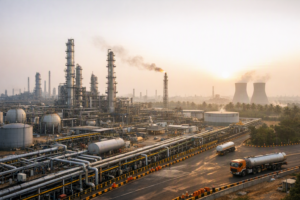
… powerful boost to India’s industry. The Union Cabinet has approved the Bhavya Rasayan Scheme (Bharat Audyogik Vikas Yojana Rasayan), a support package of ₹3,030 crore for the establishment of three specialised chemical parks in India. The scheme aims to strengthen the domestic chemical industry, attract new investment and reduce dependence on imported raw and intermediate materials. Announced in the Union Budget for FY 2026–2027, … <Read more>
China curbs chemical exports and …
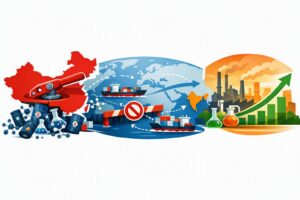
… Indian sector captures margins. China’s restrictions on chemical exports are giving Indian specialty chemical producers greater pricing power and stronger margins. At the same time, volatile oil prices and weakness in segments such as agrochemicals are creating uncertainty. The outlook remains positive, provided companies adapt in time to shifting global supply chains and economic cycles. For years, China set the pace in the global chemical industry thanks to its dominant production and export capacity. Ongoing export curbs are now tightening markets, driving … <Read more>
Chemical Sourcing in India Shifts …

… Under Pressure from West Asian Turmoil. For years, India relied heavily on countries in the Gulf region – particularly Saudi Arabia and the United Arab Emirates – for supplies of organic and inorganic chemicals. These well‑established routes suddenly came under severe pressure at the start of 2026 due to political tensions, logistical bottlenecks and shipping disruptions in West Asia. While global supply chains are still feeling the aftershocks of the coronavirus pandemic and elevated freight rates, Indian importers were forced to rethink their sourcing strategies at … <Read more>
Why India’s farmers are stuck between …

… ideal and reality. India’s agriculture stands at a critical crossroads. Many farmers want to reduce their dependence on chemical fertilisers, but they run up against outdated policies, generous subsidies and missing incentives. As a result, natural or low-chemical farming remains marginal, even though the chemical and ecological downsides of excessive fertiliser use — for soils, water and health — are well documented. The government calls for reduced fertiliser use, but in practice subsidies … <Read more>
Agrochemical revenues in India rise …

… by 6-7%! The agrochemical sector in India is experiencing a remarkable financial recovery this fiscal year, with an expected increase of 6-7% in revenues. Leading credit rating agency CRISIL points to a strong recovery in exports as the main driver behind this growth. This article highlights the various factors contributing to this development and the broader implications for the Indian economy and agricultural sector. Exports of agrochemical products have rebounded strongly after a period of uncertainty … <Read more>
The indispensable role of crystallization …

… in the fertilizer industry. In the fertilizer industry, crystallization is an essential technique that not only determines the physical and chemical properties of fertilizers, but also contributes to a more efficient production process. Here, we explore the crucial impact of crystallization on the quality and performance of fertilizers. Crystallization is a commonly used unit operation in fertilizer production. The process makes it possible to create fertilizers with controlled nutrient release … <Read more>
India imposes anti-dumping duties on …

… liquid epoxy resins from six countries. India has imposed an anti-dumping duty (ADD) on imports of Liquid Epoxy Resins (LER) originating in or exported from China (PR), Korea (RP), Saudi Arabia, Taiwan, and Thailand for a period of five years. With this measure, the Indian government aims to protect the concurrent chemical industry from what it sees as valuable competition from foreign producers offering their products below cost in the Indian market. he duties follow a formal investigation into dumping practices and are … <Read more>
Key Developments in India REACH 2025

By 2025, India has made significant strides in chemical management and environmental safety through the continued implementation of the India REACH program, known as the Chemicals Management and Safety Rules (CMSR). This program is inspired by the European REACH regulation and aims to ensure the safe use of chemicals and reduce environmental pollution in India. Although the final draft was released in 2020, as of November 2025, the regulations have still not been fully implemented. The goal has always been to replace existing rules like … <Read more>
India’s Transition to Clean Energy …
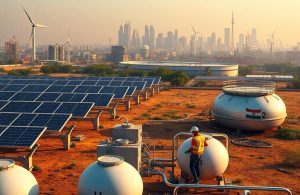
… Accelerated by Green Hydrogen Mission. The Minister of New and Renewable Energy Pralhad Joshi, announced a ₹100 crore call for proposals to support pilot projects focused on developing innovative technologies to produce green hydrogen from biomass and waste. This announcement was made during the Third International Conference on Green Hydrogen (ICGH 2025) at Bharat Mandapam, New Delhi. In his opening remarks, Joshi highlighted that the National Green Hydrogen Mission (NGHM) is pivotal … <Read more>
Proposed EU ethanol ban causes concern …
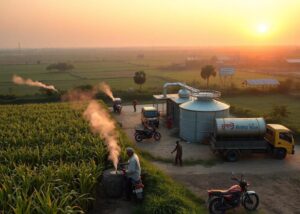
… in India. In recent years, the European Union (EU) has been working on policy measures aimed at promoting renewable energy and reducing dependence on fossil fuels. However, a recent proposal to ban the widely used biofuel ethanol has caused concern in several countries, including India. Ethanol is seen in the EU as an important renewable energy source that helps reduce CO2 emissions in the transport sector. It is produced from biomass, such as sugar … <Read more>
How government and industrial innovators …

… are accelerating India’s energy transition! Biofuels are emerging as a key driver of India’s energy transition, especially when supported by strong policies and industrial innovation. Converting waste into clean energy enhances energy security, reduces emissions, raises rural incomes, and promotes sustainable growth. India’s energy landscape is at a crossroads. With the country’s energy demand expected to nearly double by 2024, balancing economic growth with environmental responsibility has become national priority. India … <Read more>
Chemical regulation stimulates …

… economic growth and innovation in India. India is the sixth largest chemical producer in the world and the third largest in Asia. The industry is worth approximately $220 billion, with growth expected to reach $300 billion by 2030. India supplies more than 80,000 chemical products, including: Bulk products, Speciality products, Agrochemicals, Petrochemicals, Polymers and Fertilisers. The Indian government is committed to global leadership through initiatives and plans. Although … <Read more>
India introduces standard for safe handling …
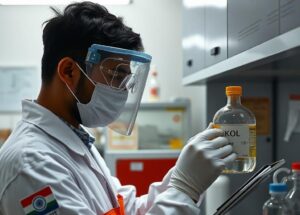
… of potassium hydroxide. In a significant step towards improving workplace safety, the Bureau of Indian Standards (BIS) published a draft version of the revised standard entitled “Caustic Potash – Code of Safety (First Revision of IS 6954)” on 25 September 2025. This is an update of the previous edition, which was first published in 1973. The proposed safety standard for caustic potash is in line with current industrial practices and aims to strengthen strict safety protocols … <Read more>
Extension of Implementation Dates for quality…

… control orders in India. he Ministry of Chemicals and Fertilisers (Department of Chemicals and Petrochemicals) of India recently announced that the implementation dates for quality control orders relating to Ethylene Dichloride, polycarbonate and vinyl chloride monomer have been extended. These measures are crucial for ensuring the quality and safety of chemical substances placed on the market. In this article, we discuss the background, impact … <Read more>
India needs a 40-fold increase in …

… non-fossil energy by 2027! India is at a turning point in its development path, with its ambition to become a developed country by 2027 going hand in hand with a necessary energy transformation. The recently published EY-CII report emphasises that India needs a 40-fold increase in non-fossil energy sources to realise this ambition. In this article, we explore the challenges, opportunities and strategies required for this ambitious transition. In 2023, India’s energy production will still be largely de- … <Read more>
India’s chemical sector experiences …

… unparalleled growth. In recent years, India’s chemical sector has made impressive strides, attracting the attention of investors worldwide. With a total shareholder return of 28%, the sector significantly outperforms the global average of 7%. In this article, we explore the factors contributing to this remarkable growth and the future prospects for this dynamic industry. One of the key factors behind the growth of the Indian chemical sector is the increase in innovation … <Read more>
CCFI recommends lifting ban on 12 chemicals …
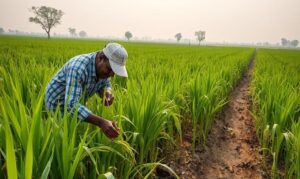
… used in pest control. The Confederation of Crop Protection Industries (CCFI) recently recommended lifting the proposed ban on twelve specific chemical molecules used for pest control in basmati rice cultivation in the Punjab region. The implications of this recommendation are significant and affect not only the agricultural and economic landscape of Punjab, but also the broader global trade dynamics of this premium rice variety. Basmati rice is known for its … <Read more>
PMFAI India urges government action against …

… US tariff shock. The Department of Agriculture and Farmers Welfare has officially announced the inclusion of six new insecticides in the list of the Insecticides Act, 1968, through notification S.O. 2703(E) dated June 13, 2025. The Pesticides Act, 1968 regulates the import, manufacture, sale, transportation, distribution, and use of pesticides in India to ensure the safe and effective use of pesticides while … <Read more>
India adds six new insecticides to the …

… Insecticides Act of 1968. The Department of Agriculture and Farmers Welfare has officially announced the inclusion of six new insecticides in the list of the Insecticides Act, 1968, through notification S.O. 2703(E) dated June 13, 2025. The Pesticides Act, 1968 regulates the import, manufacture, sale, transportation, distribution, and use of pesticides in India to ensure the safe and effective use of pesticides while minimizing risks to human health, animal welfare, and the … <Read more>