India aims to grow its chemicals sector into a $1 trillion industry
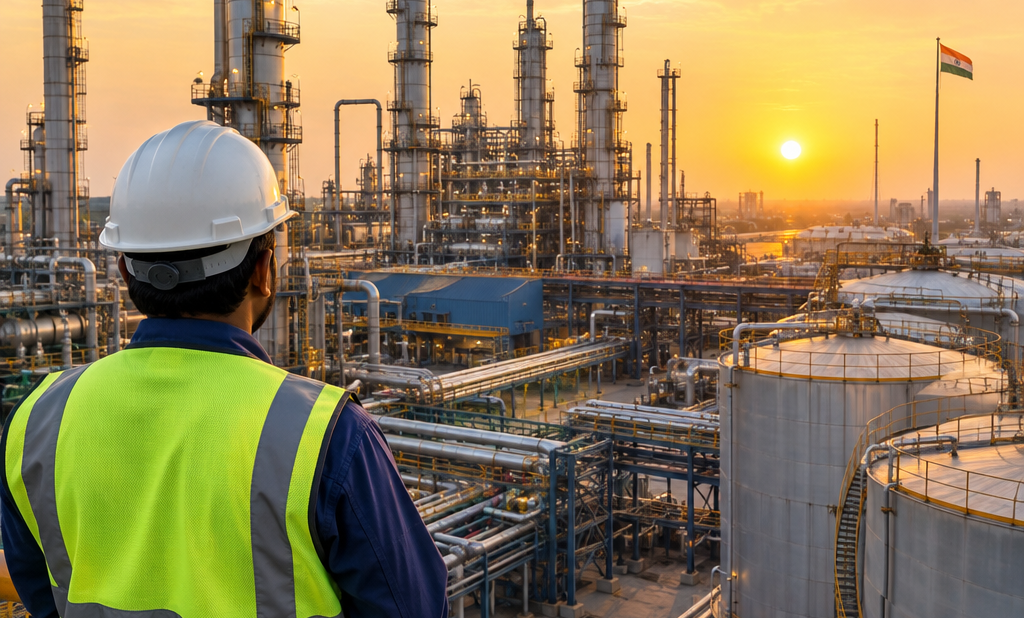
Image: AI-generated
India aims to grow its chemicals sector into a $1 trillion industry – India wants to build its chemicals and petrochemicals industry into a major driver of manufacturing. The government is targeting a sector value of $1 trillion by 2040. The industry is currently estimated to be worth around $220 billion, and could reach $300 billion by 2030. These are ambitious projections, dependent on investment, technological development and the effective implementation of government policy.
Essential to a wide range of industries
The sector’s importance extends far beyond factories that produce chemicals. Raw materials and intermediate products from the industry are needed in pharmaceuticals, agriculture, textiles, construction, automobiles, electronics and consumer goods, among other fields. Growth in chemicals can therefore have an impact across a broad part of the economy. India sees the sector as a link between raw materials, industrial production and the finished goods sold in domestic and international markets.
A strong starting position
According to the figures cited, India is the world’s sixth-largest producer of chemicals and the fourth-largest in Asia. The country is also a major manufacturer and exporter of dyes, and ranks among the largest exporters of agrochemicals. The industry is estimated to comprise 13,000 large companies and 445,000 micro, small and medium enterprises (MSMEs). This combination of large producers and smaller businesses provides a broad base for further expansion.
Production and investment are increasing
Production of major chemicals and petrochemical products rose from 45.638 million tonnes in fiscal year 2015–16 to 58.617 million tonnes in 2024–25. Foreign investment also increased, according to the figures cited: inflows between 2014 and 2026 totalled 1,04,895 crore rupees, compared with 45,240 crore rupees between 2004 and 2014. In most chemical subsectors, India allows 100% foreign ownership through the automatic investment route, which generally does not require prior approval.
Industrial clusters bring facilities together
A key part of the growth strategy is the development of integrated industrial regions. The so-called Petroleum, Chemicals and Petrochemicals Investment Regions (PCPIRs) bring factories, infrastructure and support services together. This allows companies to share facilities instead of building everything separately.
Three PCPIRs, thousands of businesses
India has three PCPIRs: Dahej in Gujarat, the Visakhapatnam–Kakinada region in Andhra Pradesh, and Paradeep in Odisha. Each region covers about 250 square kilometres, with around 40% set aside for industrial processing. Facilities may include roads, rail links, ports, water supply, steam supply, and wastewater and waste-management plants.
Investment and jobs
Together, the three PCPIRs have attracted 3.4 lakh crore rupees in investment and generated 3.7 lakh jobs, according to the figures cited. They have also enabled more than 2,200 chemical manufacturing units to be established. The cluster model is intended to ease practical bottlenecks, improve efficiency and make large-scale investment more attractive.
New chemical parks
In July 2026, the government approved the Bharat Audyogik Vikas Yojana Rasayan (BHAVYA Rasayan) scheme, which is intended to support the development of three specialised chemical parks. A total of 3,030 crore rupees has been allocated to the programme: 3,000 crore for shared infrastructure and basic facilities, and 30 crore for administrative costs. Implementation is planned over five years, from fiscal year 2026–27 through 2030–31.
Facilities from the outset
Each new park must cover at least 8 square kilometres. The central government may contribute up to 1,000 crore rupees per park, while the state concerned must contribute at least 500 crore. The parks are intended to give companies ready access to facilities such as wastewater treatment, storage and hazardous-waste processing. This so-called plug-and-play infrastructure could help businesses start operating sooner and reduce the need for them to develop basic facilities themselves.
Room for plastics processing, too
Alongside chemical parks, India is encouraging the growth of its plastics-processing industry. Plastics parks are designed to bring together businesses that turn polymers into a wide range of products. This could increase domestic demand for polymers, add value and create opportunities for investment, manufacturing, exports and employment.
Ten plastics parks approved
The government may subsidise up to 50% of a park’s project costs, up to a maximum of 40 crore rupees per project. State governments, companies and other stakeholders provide the rest. Ten plastics parks have been approved, and four had completed their infrastructure in full. According to the text, three of these were completed in 2025–26. The parks are intended to combine growth with waste management and recycling.
Research as a driver of growth
Increasing production alone will not be enough to achieve these ambitions. The sector also needs new technologies, specialised expertise and higher-value products. The government is therefore supporting research, knowledge-sharing and collaboration between research institutions and businesses. The Chemical Promotion and Development Scheme (CPDS) funds studies, databases, workshops and seminars, among other activities.
Guidance for farmers
One part of CPDS provides guidance on the safe and responsible use of pesticides. HIL (India) has conducted training for farmers since 2016, and the Institute of Pesticide Formulation Technology joined the programme in 2022–23. The training promotes careful pesticide use and integrated pest management. According to the figures cited, more than 250 programmes had reached over 100,000 farmers by August 2026.
More funding for advanced technology
Launched in November 2025, the Research, Development and Innovation Scheme (RDI) has a fund of 1 lakh crore rupees. The programme aims to encourage private-sector investment in research through long-term financing and refinancing on favourable terms. Since 8 October 2026, advanced chemicals, petrochemicals and materials technologies have also been among the eligible areas. This could support research into home-grown technologies and industrial applications.
Training and innovation
Further growth will also require a sufficient skilled workforce. The Central Institute of Petrochemicals Engineering & Technology (CIPET) provides training, technical consultancy and research. Its network comprises 51 centres, including 19 established since 2014. According to the figures cited, CIPET has trained nearly 672,000 professionals and completed more than 853,000 technical-support assignments between 2014 and 2024.
Quality and safety
India has also established 18 Centres of Excellence to improve existing technologies and develop new applications. Together, these centres have filed 85 patents, published more than 600 research papers, and developed 105 technologies and products. At the same time, Quality Control Orders (QCOs) cover an increasing number of products: as of August 2026, 37 such orders were in force. They require producers and importers to meet standards set by the Bureau of Indian Standards.
Safer handling of hazardous substances
As the sector expands, sound safety practices become even more important. A nationwide training programme is intended to teach workers how to handle hazardous chemicals safely and reduce the risks involved. It targets all 2,393 so-called MAH units—companies that handle large quantities of hazardous substances—and is scheduled to run for five years. As of August 2026, 21 training sessions had been held, involving 1,376 industrial units and training 2,441 employees.
From ambition to implementation
India Chem 2026 provided a platform to promote the sector’s international ambitions. The plans combine increased production with new industrial clusters, research, training, quality standards and safety measures. The target of reaching $1 trillion by 2040 is therefore about more than building additional factories. Access to infrastructure, technology, skilled workers and investment capital will also be decisive. If these elements come together, India could strengthen its role in global value chains and become a major hub for chemicals, petrochemicals and advanced materials.
Source: Indian Chemical News
Also read: Laboratorium Almabe behaalt ENAC-accreditatie voor drie cosmeticatests
Reservation
This information has been compiled with the greatest possible care, in some cases from different information sources and sometimes with the help of AI. (Interpretation) errors are not excluded. No legal obligation can therefore be derived from this text. Everyone dealing with this subject has the responsibility to delve into the matter!