India’s Transition to Clean Energy Accelerated by Green Hydrogen Mission
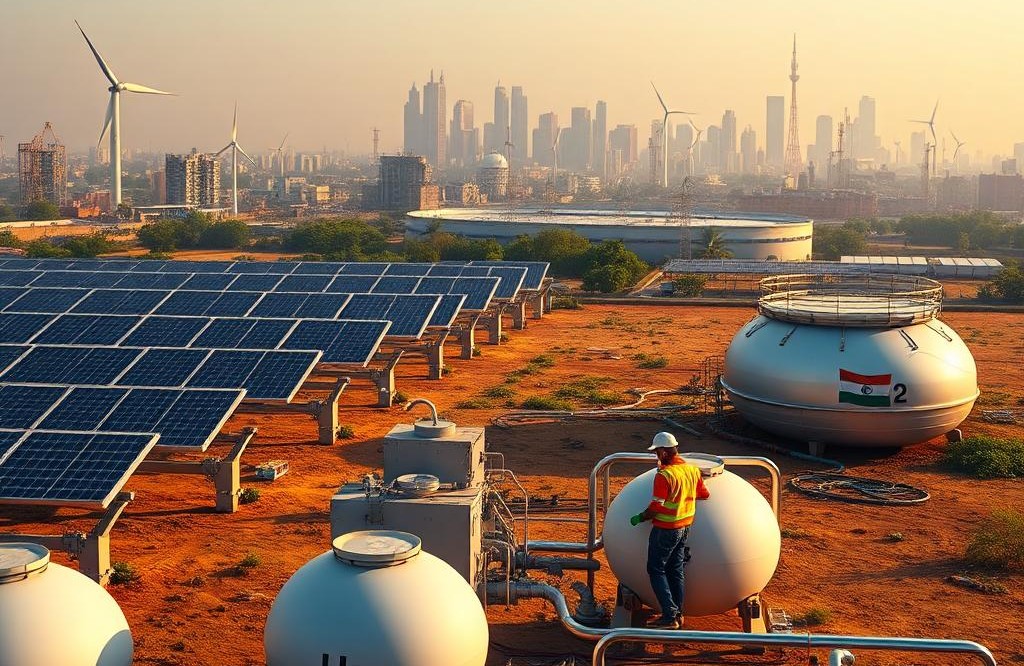
Image: AI-generated
India’s Transition to Clean Energy Accelerated by Green Hydrogen Mission – The Minister of New and Renewable Energy Pralhad Joshi, announced a ₹100 crore call for proposals to support pilot projects focused on developing innovative technologies to produce green hydrogen from biomass and waste. This announcement was made during the Third International Conference on Green Hydrogen (ICGH 2025) at Bharat Mandapam, New Delhi.
In his opening remarks, Joshi highlighted that the National Green Hydrogen Mission (NGHM) is pivotal in advancing India’s transition to clean energy by generating employment, attracting investment, and establishing India as a global hub for green hydrogen. He also introduced the official NGHM logo, chosen from over 2,500 submissions nationwide, representing citizen involvement and creativity in driving India’s green revolution.
Decarbonizing Challenges
Launched in 2023 with a budget of ₹19,744 crore, the NGHM is designed as a global initiative to decarbonize challenging sectors. Joshi described the mission as the “fuel of a new civilization” and a crucial step towards achieving long-term energy independence.
Significant Progress in the SIGHT Program
The minister reported significant strides under the Strategic Interventions for Green Hydrogen Transition (SIGHT) initiative. Incentives have been provided for 3,000 MW annually of domestic electrolyser production. Green hydrogen production has reached 8.62 lakh metric tonnes per annum (MTPA). India boasts the lowest global price for green ammonia at ₹49.75 per kg with a production of 7.24 lakh MTPA. Furthermore, the government has:
- Invested ₹132 crore in five green steel pilot projects.
- Approved ₹208 crore for 37 hydrogen vehicles and nine refuelling stations.
- Allocated ₹35 crore for India’s inaugural hydrogen bunkering and refuelling facility at the V.O. Chidambaranar port.
New Initiative for Biomass-Based Hydrogen Projects
Joshi announced that the Ministry of New and Renewable Energy (MNRE) will issue proposals for pilot projects utilizing biomass and waste for green hydrogen production. This initiative, administered by the Biotechnology Industry Research Assistance Council (BIRAC), seeks to engage industries, start-ups, and research institutions. Funding is supplementary to the ₹100 crore already earmarked for start-ups under NGHM. Joshi emphasized that this initiative will bolster India’s innovation ecosystem, showcasing cost-effective, scalable technologies to advance the hydrogen economy.
Developing a Skilled Green Hydrogen Ecosystem
Joshi also highlighted India’s advances in building a skilled workforce and robust regulatory frameworks. Forty-three qualifications related to hydrogen skills have been approved, and over 6,300 trainees have been certified. New standards, including the Green Hydrogen Standard (2023) and a certification program (2025), alongside 128 technical standards, have been introduced to ensure quality and safety. “Green hydrogen is now an economic necessity, not just an option,” Joshi stated, noting India’s efforts to stay competitive and climate-resilient amid new global carbon regulations.
Global Collaboration at ICGH 2025
The minister described ICGH 2025 as a platform bringing together scientists, policymakers, and industry leaders to hasten sustainable innovation, signifying a shared commitment to a cleaner, inclusive energy future.
India’s Renewable Energy Progress and Future Aims
Economic Affairs Minister Santosh Kumar Sarangi announced that India’s non-fossil installed capacity has surpassed 250 GW, featuring:
- 130 GW of solar energy
- Over 50 GW of wind energy
- 17 GW of bioenergy and small hydropower
India aims to achieve 500 GW of renewable capacity by 2030. The NGHM is expected to mobilize ₹8 lakh crore in investments and save ₹1 lakh crore annually on fossil fuel imports.
Advancing Towards a Green Hydrogen Future
With these initiatives, India is making steady progress towards a self-reliant, sustainable hydrogen economy. The ₹100 crore biomass-based hydrogen pilot initiative marks another significant step toward leveraging native resources and spurring green innovation for a cleaner, more resilient future.
Source: Chemical Industry Digest
Also read: Proposed EU ethanol ban causes concern in India
Reservation
This information has been compiled with the greatest possible care, in some cases from different information sources and sometimes with the help of AI. (Interpretation) errors are not excluded. No legal obligation can therefore be derived from this text. Everyone dealing with this subject has the responsibility to delve into the matter!