Three new chemical parks to give powerful boost to India’s industry
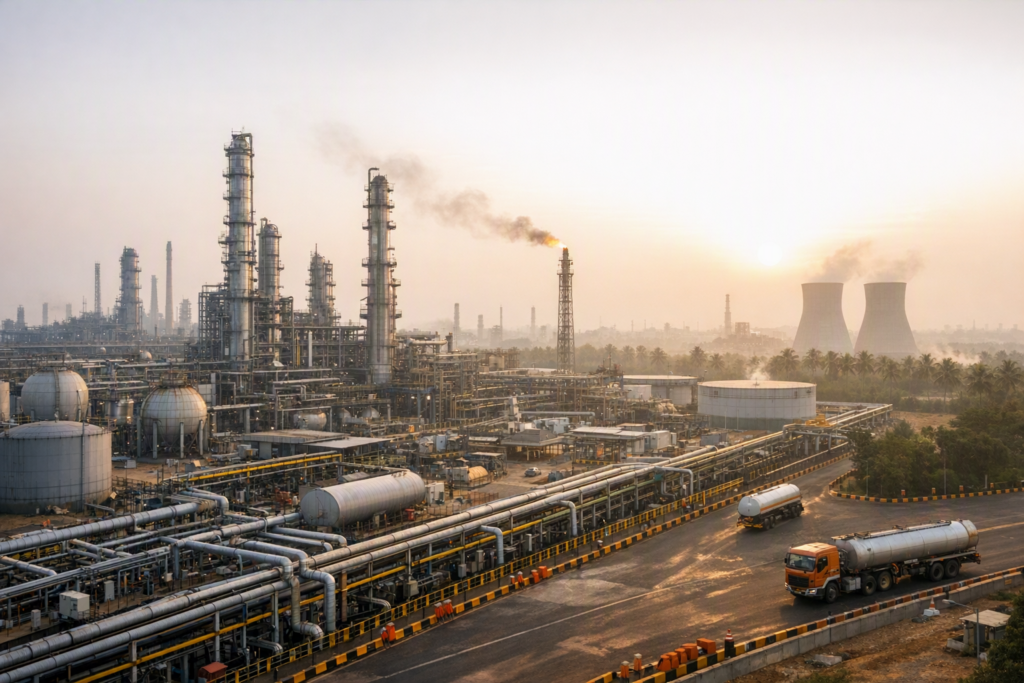
Image: AI-generated
Three new chemical parks to give powerful boost to India’s industry – The Union Cabinet has approved the Bhavya Rasayan Scheme (Bharat Audyogik Vikas Yojana Rasayan), a support package of ₹3,030 crore for the establishment of three specialised chemical parks in India. The scheme aims to strengthen the domestic chemical industry, attract new investment and reduce dependence on imported raw and intermediate materials.
Announced in the Union Budget for FY 2026–2027, the scheme will run for five years, from 2026–2027 to 2030–2031. Of the total outlay, ₹3,000 crore is earmarked for the development of common infrastructure and basic facilities in the parks. The remaining ₹30 crore is reserved for administration and implementation of the scheme.
Shared investment by Union and state governments
Under the scheme, each chemical park can receive a central government grant of up to ₹1,000 crore, on the condition that the respective state government contributes at least ₹500 crore of its own funds. This co-funding model is intended to ensure that the states share ownership of the development and management of the new industrial clusters.
Selection based on competition and scale
The three locations will be selected through a competitive process based on pre-defined criteria. Each park must offer at least 8 square kilometres (around 2,000 acres) of contiguous, litigation-free land. The parks will serve as plug-and-play locations for chemical manufacturers, with fully developed facilities that companies can use immediately.
Comprehensive, shared infrastructure for producers
Facilities will include common effluent treatment plants, treatment, storage and disposal facilities for waste, water supply and distribution systems, solvent recovery and distillation units, steam generation and distribution plants, interconnected pipeline networks, and extensive logistics and warehousing infrastructure. This will significantly reduce the need for individual companies to invest in basic infrastructure.
Lower costs and stronger integration into global markets
According to the government, the scheme is designed to strengthen the entire value chain, from suppliers and basic chemical producers to processing and downstream industries. Shared infrastructure is expected to reduce logistics bottlenecks and lower operating costs for manufacturers by an estimated 20–30 percent. At the same time, the initiative aims to better integrate India into global value chains, boost exports, substitute imports and enhance the sector’s international competitiveness.
Greater sustainability and stricter environmental compliance
By providing centralised facilities for the treatment of hazardous and non-hazardous waste, the government seeks to further tighten environmental standards in the chemical sector. Integrated waste management and more efficient use of resources are expected to support more sustainable, environmentally friendly industrial development.
Broad impact on other sectors and a long-term vision
The new chemical parks are expected to strengthen a wide range of downstream sectors, including agriculture, textiles, pharmaceuticals, nutraceuticals, construction, automotive and electronics. In doing so, they support the Viksit Bharat 2047 vision of a developed India and the broader goal of a more self-reliant, Atmanirbhar economy.
Source: ChemicalWeekly
Also read: China curbs chemical exports and Indian sector captures margins
Reservation
This information has been compiled with the greatest possible care, in some cases from different information sources and sometimes with the help of AI. (Interpretation) errors are not excluded. No legal obligation can therefore be derived from this text. Everyone dealing with this subject has the responsibility to delve into the matter!